 |
| The original, unedited photo found on the cover of my Middle Eastern History textbook. |
Every time I turn on the television there's some new breaking story (read: lore) out of the Middle East that I inevitably know nothing about. This frustrates me because as a chemistry graduate student, I'm already blessed with more than enough opportunities to show off my staggering ignorance on a daily basis. In research there's just too many details to keep track of, too many things that can go wrong, and too many concepts to remember all at once. I am a professional idiot. So when something outside of my already self-esteem crushing job doesn't make sense to me, I have this weird knee-jerk response to get at least some small understanding of it.
So I boot up my computer and browse the internet in hopes of learning more about the newest drama to come out of the Middle East. Only the thing about current events is that they are the result of past events (duh). It's usually at this point that I start backtracking to get a handle on some of those past events. But here's the problem: the Middle East's past events were caused by even older past events, and those even older past events were caused by MUCH older past events and so on and so forth and on and on and on, literally all the way back to the beginning of civilization about 9,000 years ago.
What I'm saying is without a complete understanding of its history, none of what's going on today over in the Middle East will ever make sense to any of us. It's like watching Lost for the first time by starting with an episode midway through season four. You can't just skip the early stuff or else you'll wind up at the water cooler the next day lecturing your co-workers on this theory you have about a character that everyone but you knows is actually just a figment of Jack's imagination acting as a manifestation of his guilt for his cocaine addiction that started as a means to cope with the bullying he experienced as a middle schooler (I've never watched Lost).
With all of this in mind, and motivated by the fact that US foreign policy seems to be inextricably tied to the Middle East, I've decided I'm going back to the beginning. Of everything. To the very first season of the "Middle East" -- the pilot episode. And I'm going to learn about all of it, all the way to whatever is happening today. It's going to be like binge-watching all the seasons of Friends on Netflix, except more fun.
But first an introduction.
An introduction to the Middle East and the things pertaining to it that are kind of important
"Where is the middle East?"
The best part about the term "middle" East is that it's pretty inexact. Since I'm really good at getting things almost right, it's precisely the kind of term I like best.
Below is an artist's rendition of what the world looks like in my head. We can see that the Middle East is placed neatly between the two regions that are "East" and "really East" of my position.
 |
| The world according to me. |
After doing some digging, it turns out that the term "Middle East" has nothing to do with its location relative to where I am. Apparently a long time ago, some Europeans who thought they were more important than me decided the world should be labeled relative to their position instead of mine. Hence the name "mid-East" or "Near East," due to its close proximity to Europe. So I guess a more accurate world map would look like this.
 |
Real nice Europe. It's not like I'm the one at the center of the map or anything.
|
Now that we have an idea of where the Middle East is, let's look at some of the things that make it so gosh darn unique.
Thing 1: Complex Distribution of Ethnic Groups
Below is a map of the countries that make up the Middle East. At first glance it's not that complicated. It's a pretty small area consisting of several countries. You've got some Syrians in Syria next to the Iraqis living in Iraq and Iranians living in Iran...Not bad. This kind of map is simple and nice to read and I imagine it being a happy map because everything just makes sense.
 |
| This is our happy map. What a nice, simple, easy to read map. (Although it's missing Afghanistan and Pakistan, but nobody's perfect.) |
Feeling pretty confident about our Middle East geography, let's go ahead and zoom in to Israel to get some more detail. I chose because Israel it's just barely larger than the state of New Jersey, so it can't be that confusing.
 | |
|
Let's talk this one out. What's with that green country (Palestine) being split into three pieces? Why is the city of Jerusalem only kind of halfway in Israel? And what's going on in that little seersucker hashed blue zone to the north? Is that a good thing or a bad thing? Should I be avoiding this area or is it some kind of carnival fairgrounds?

Also if you know anything about the middle east, you probably have heard that Israel and Palestine (the green areas on the map) don't exactly get along. So who voluntarily splits their country in three parts and then puts each piece on either side of their least favorite neighbor? What if the grocery store is on the East side in Hebron but you live on the West side in Khan Yumia? Everybody knows how horrible traffic in Beersheba is.

For a country as small as Israel, this is all obnoxiously confusing. Last time I checked, New Jersey's border wasn't this complicated. Yeah it's got a lot of squiggles, but it doesn't split any nearby states in half (although it does kind of deform NY), there's no random cities inside of it that technically don't count as part of it, and it's devoid of all ambiguous blue hashed zones.
To illustrate this point, I've made a graph of object size vs "shape what-the-fuckness." The green area near the line that goes through the center of the graph is where you want to be if you're an object. It's our area of pleasing shapeliness, and it's reserved for objects that have an appropriate amount of complexity given their size.
 |
| Things below the line of pleasing shapeliness are abnormally simple for how large they are. Things above the line are carrying around way too much complexity for their small size. |
Looking at this graph we can see a few things. First of all, just about the only thing larger and more boring than Montana is the sun. The US pentagon is fairly large, but it only has five sides which is pretty embarrassing. On the other side of our the line we have objects that are too weirdly shaped. Interestingly, Gary Busey's head is one of the few objects that is both a little too big and a little too weirdly shaped. And then we have the deep red zone in the top left corner. It's reserved for the tiniest and most complicated of things. Like the GNAS complex locus protein, which Israel is just barely larger and yet infinitely more complicated than.
At this point I'm starting to get that all too familiar feeling of ignorance and bewilderment, so let's go back to our happy, simpler map from before. But now if we add in the areas of different ethnic groups in the Middle East, things quickly go from "hey I can totally read this map and get useful information out of it" to "holy hell what the shit am I looking at."
 |
| How are there even that many different kinds of people in such a small area? And why is there an entire novel in the lower right hand corner of this map? It's good to see Afghanistan back, though. (http://www.vox.com/a/maps-explain-the-middle-east) |
See that massive red dark spot in the middle? Those are the Kurds. But when you look back at our simple map from earlier (remember how nice things were back then?), you'll notice there is no "Kurdistan." In fact, the entire belt from Turkey to Afghanistan is a cornucopia of colors not represented by countries.
 |
| That's a large amount of Kurds. But why no Kurdistan? This gives our map an identity crisis and makes him sad. |
So why don't all of these culturally unique people each have their own countries? And why does it seem like a lot of the borders to these countries were randomly drawn by idiots who had no understanding of the cultural differences in the Middle East?
Thing 2: A lot of the borders were drawn by idiots who had no understanding of the cultural differences in the Middle East
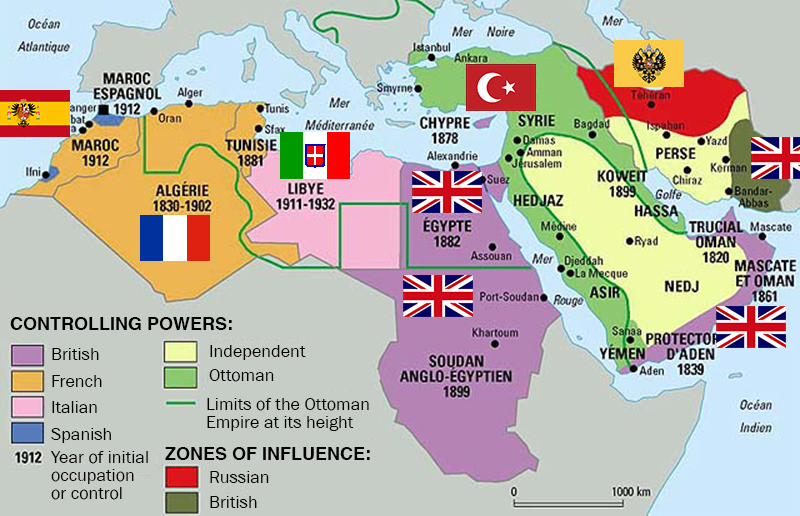
By the end of WW1, the Ottoman Empire had been defeated and it was up to the European nations to carve up the remaining land. So naturally they just closed their eyes and scribbled on a map.
 |
| http://www.vox.com/a/maps-explain-the-middle-east |
This is important because each country imposed different policies on their respective zones of influence and also because when the countries gained independence, these borders were kept.
Thing 3: Religious Complexity
Most of us know that Christianity, Judaism, and Islam all started in the Middle East, so they're pretty prominent. You've also probably heard about how there are two different factions of the Islamic faith: Sunni and Shiite. Aren't we smart? Here's what the distribution of those two factions looks like:
 |
| You can tell this map isn't going to be too confusing because it only has two colors (not including the ocean). http://www.vox.com/a/maps-explain-the-middle-east |
If we zoom into Syria and take a closer look at it's religious diversity we get the following techno-party map.
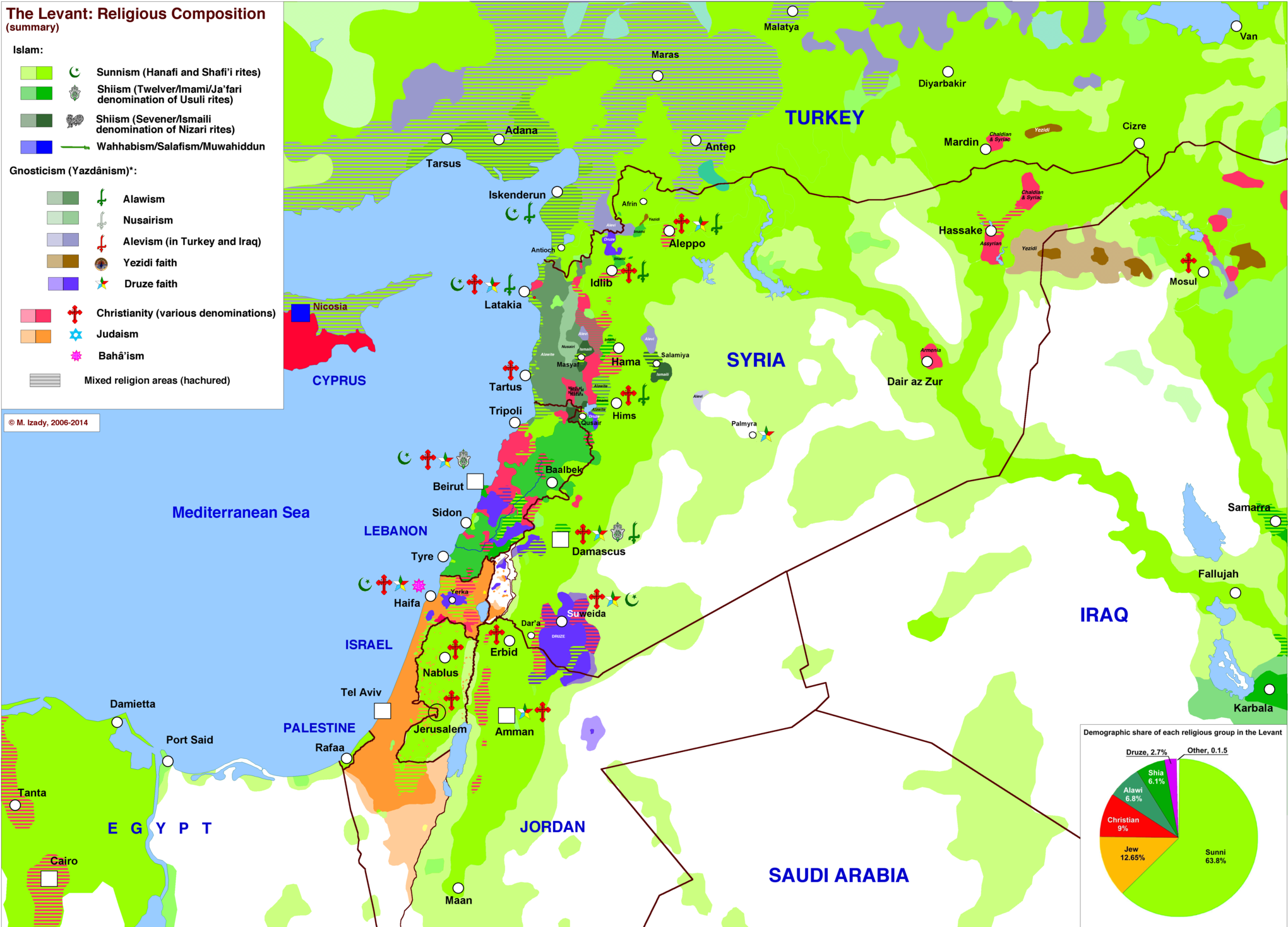 |
| This map is like the neon techno party of religious dispersion and it's giving me a seizure just looking at it. Also note the return of the ambiguously marked hashed areas. http://www.vox.com/a/maps-explain-the-middle-east |
Lebanon features communities of Sunnis, Shias, Christians, and Druze (whatever that is). A 15 year civil war from 1975 to 1990 led to a lot of killing between these religious groups. Now a similar war is occurring in Syria, which is majority Sunni, but has sizable groups of Christians, Druze, and Shia. An interesting and probably important note about Syria is that despite being the minority religion, Bashar al-Assad and much of his government are all Shia Muslim.
Thing 4: Global Position and Resources (AKA, the final piece needed for a perfect shitstorm)
Okay, things are pretty complicated in the middle east. But remember, the Middle East is really, really far away. So why does it matter to us? How come every time I turn on the news I'm hearing about it?
The answer to that, you might have guessed, is pretty complicated; but it also helps explain why the region continues to be so unstable. See, by some kind of horrific stroke of bad luck, this already sensitive region happens to be a key global geo-political strategic hotspot. Because of course it is.
For this reason, Geographer Saul Bernard Cohen calls the middle east a "shatter-belt," which he describes in his book as:
"a region torn by internal conflicts whose fragmentation is increased by the intervention of external major powers. The interveners seek to extend their influence over the region by offering military, political, and economic support to their clients."
THE SHATTERBELT (read in a slow gravelly monster truck announcer's voice from now on) might be the coolest and simultaneously worst name you could have to describe your living space. Whenever I hear it, I think of one of those WWE heavyweight champion belts you see wrestlers carrying around all the time.
 |
| SUNDAY SUNDAY SUNDAY |
And the rest of the world is a bunch of world class WWE RAW SHOWDOWN wrestlers.

And so all the countries of the world are wrestling over control of the SHATTERBELT.
Unfortunately for the citizens living in the Middle East, all this fighting in their backyards tends to mess things up.
Most recently, the Middle East SHATTERBELT has been the meeting point between the US and Russia during the Cold war. With tensions rising again between the US and China/Russia, it makes sense that the US is a bit worried about what's going on here.
What's crazy is that this isn't the first time the Middle East has served as the meeting point for global superpower. Well before the Cold War, it was fought over by British Empire and Romanov Russia, and before that it was the battle grounds between the Byzantine and Ottoman empires. As we'll learn, the Middle East has somehow consistently been the exact spot where the world's competing superpowers somehow end up meeting. For thousands of years. Shit.
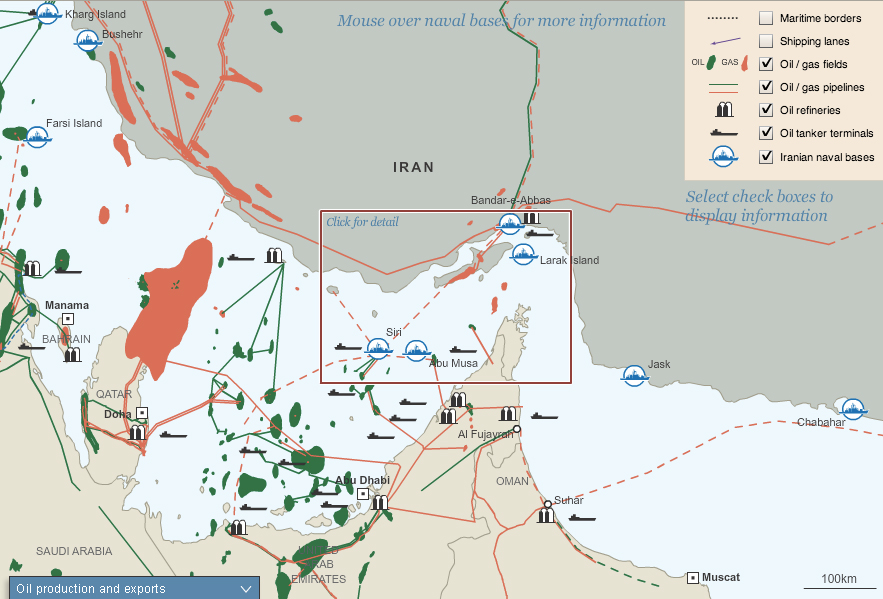
In addition to just being in the wrong place at the wrong time, the SHATTERBELT is also important for its resources. Now I'm sure you've already heard that oil is a pretty big deal in the Middle East. But oil isn't the only thing. There are two sub-things I want to point out.
Sub-Thing 4.1: The Straight of Hormuz
Just about all of the oil exported from the middle east is dependent on access to this narrow path of water between Iran and the Arabian peninsula. In 1980, President Jimmy Carter saw just how important of a piece it was to holding influence over the SHATTERBELT, so he positioned US forces in such a way that they could suplex the shit out of anyone that threatened our access to it. This was known as the "Carter Doctrine" which is a decidedly benign name for a wrestling move that when performed could ignite a third world war.
 |
| http://www.vox.com/a/maps-explain-the-middle-east |
Naturally, all the other countries yearning for control of the SHATTERBELT decided they should do the same, and now this tiny stretch of water is one of the most heavily militarized in the world.
Sub-Thing 4.2: Suez Canal
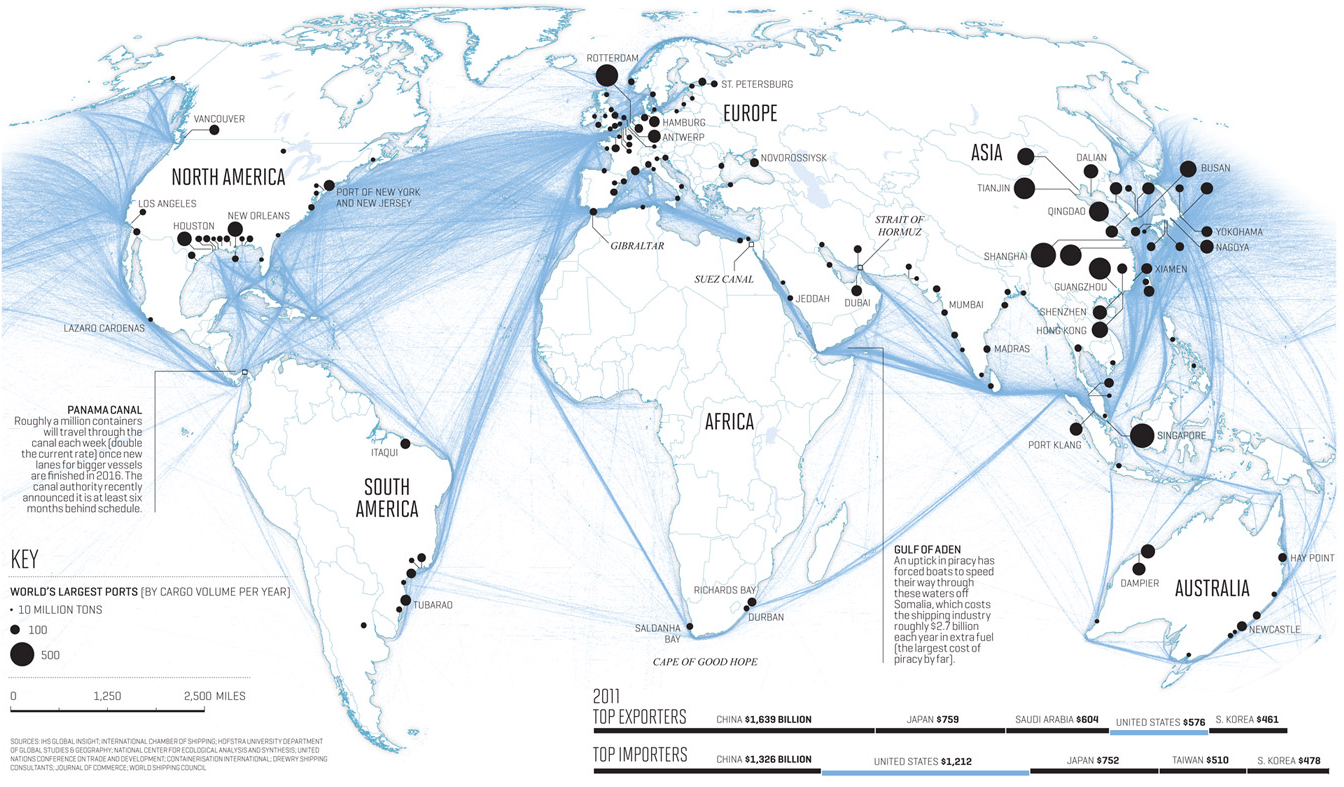
The Suez Canal was built in 1868. Located in Egypt, it's only 10 miles long, but incredibly important in that it made transport of good between Europe and Asia infinitely easier. Today, about 8 percent of all global trade makes its way though this stretch of water. It's so important, that in the 1880s, the major world powers signed a contract that the canal would "forever be open to ships of all nations no matter what"; an agreement that I'm sure nobody is ever going to break.
 |
| http://www.vox.com/a/maps-explain-the-middle-east |
Let's recap.
So why did this happen? what can we do about all of this? How do we address these problems? Is there ever going to be a solution?
The answers to these questions go back a long, long way. Well before ISIS had twitter, before humans had computers, before the cold war, before WW2 and WW1, before we knew about oil, before expansive empires and the birth of religion, before the invention of writing and pottery, before the formation of the world's first city, back before human civilization as we know it even existed.
That's where we start next time: 6 million BC.
<script>
(function(i,s,o,g,r,a,m){i['GoogleAnalyticsObject']=r;i[r]=i[r]||function(){
(i[r].q=i[r].q||[]).push(arguments)},i[r].l=1*new Date();a=s.createElement(o),
m=s.getElementsByTagName(o)[0];a.async=1;a.src=g;m.parentNode.insertBefore(a,m)
})(window,document,'script','//www.google-analytics.com/analytics.js','ga');
ga('create', 'UA-64536787-1', 'auto');
ga('send', 'pageview');
</script>

Who was your art teacher at LS? They need to be fired.
ReplyDeleteLOL
Well done other wise!
Dad
To quote Forrest Gump: " Jon always had a way of explaining things so that I could understand them... " well done sir.
ReplyDeletewell done!
ReplyDeleteGreat article!
ReplyDelete