Tuesday, June 30, 2015

Thursday, June 25, 2015
History of the Middle East: Prologue
To me the history of the Middle East is just like the Lord of the Rings saga. It's impossibly complicated, there's more fan-fiction than any of us are really comfortable with, and I can't pronounce any of the people's names.
Every time I turn on the television there's some new breaking story (read: lore) out of the Middle East that I inevitably know nothing about. This frustrates me because as a chemistry graduate student, I'm already blessed with more than enough opportunities to show off my staggering ignorance on a daily basis. In research there's just too many details to keep track of, too many things that can go wrong, and too many concepts to remember all at once. I am a professional idiot. So when something outside of my already self-esteem crushing job doesn't make sense to me, I have this weird knee-jerk response to get at least some small understanding of it.
So I boot up my computer and browse the internet in hopes of learning more about the newest drama to come out of the Middle East. Only the thing about current events is that they are the result of past events (duh). It's usually at this point that I start backtracking to get a handle on some of those past events. But here's the problem: the Middle East's past events were caused by even older past events, and those even older past events were caused by MUCH older past events and so on and so forth and on and on and on, literally all the way back to the beginning of civilization about 9,000 years ago.
What I'm saying is without a complete understanding of its history, none of what's going on today over in the Middle East will ever make sense to any of us. It's like watching Lost for the first time by starting with an episode midway through season four. You can't just skip the early stuff or else you'll wind up at the water cooler the next day lecturing your co-workers on this theory you have about a character that everyone but you knows is actually just a figment of Jack's imagination acting as a manifestation of his guilt for his cocaine addiction that started as a means to cope with the bullying he experienced as a middle schooler (I've never watched Lost).
With all of this in mind, and motivated by the fact that US foreign policy seems to be inextricably tied to the Middle East, I've decided I'm going back to the beginning. Of everything. To the very first season of the "Middle East" -- the pilot episode. And I'm going to learn about all of it, all the way to whatever is happening today. It's going to be like binge-watching all the seasons of Friends on Netflix, except more fun.
But first an introduction.
"Where is the middle East?"
The best part about the term "middle" East is that it's pretty inexact. Since I'm really good at getting things almost right, it's precisely the kind of term I like best.
Below is an artist's rendition of what the world looks like in my head. We can see that the Middle East is placed neatly between the two regions that are "East" and "really East" of my position.
After doing some digging, it turns out that the term "Middle East" has nothing to do with its location relative to where I am. Apparently a long time ago, some Europeans who thought they were more important than me decided the world should be labeled relative to their position instead of mine. Hence the name "mid-East" or "Near East," due to its close proximity to Europe. So I guess a more accurate world map would look like this.
Now that we have an idea of where the Middle East is, let's look at some of the things that make it so gosh darn unique.
Below is a map of the countries that make up the Middle East. At first glance it's not that complicated. It's a pretty small area consisting of several countries. You've got some Syrians in Syria next to the Iraqis living in Iraq and Iranians living in Iran...Not bad. This kind of map is simple and nice to read and I imagine it being a happy map because everything just makes sense.
Feeling pretty confident about our Middle East geography, let's go ahead and zoom in to Israel to get some more detail. I chose because Israel it's just barely larger than the state of New Jersey, so it can't be that confusing.
Okay. So there's that.
Let's talk this one out. What's with that green country (Palestine) being split into three pieces? Why is the city of Jerusalem only kind of halfway in Israel? And what's going on in that little seersucker hashed blue zone to the north? Is that a good thing or a bad thing? Should I be avoiding this area or is it some kind of carnival fairgrounds?

Also if you know anything about the middle east, you probably have heard that Israel and Palestine (the green areas on the map) don't exactly get along. So who voluntarily splits their country in three parts and then puts each piece on either side of their least favorite neighbor? What if the grocery store is on the East side in Hebron but you live on the West side in Khan Yumia? Everybody knows how horrible traffic in Beersheba is.

For a country as small as Israel, this is all obnoxiously confusing. Last time I checked, New Jersey's border wasn't this complicated. Yeah it's got a lot of squiggles, but it doesn't split any nearby states in half (although it does kind of deform NY), there's no random cities inside of it that technically don't count as part of it, and it's devoid of all ambiguous blue hashed zones.
To illustrate this point, I've made a graph of object size vs "shape what-the-fuckness." The green area near the line that goes through the center of the graph is where you want to be if you're an object. It's our area of pleasing shapeliness, and it's reserved for objects that have an appropriate amount of complexity given their size.
Looking at this graph we can see a few things. First of all, just about the only thing larger and more boring than Montana is the sun. The US pentagon is fairly large, but it only has five sides which is pretty embarrassing. On the other side of our the line we have objects that are too weirdly shaped. Interestingly, Gary Busey's head is one of the few objects that is both a little too big and a little too weirdly shaped. And then we have the deep red zone in the top left corner. It's reserved for the tiniest and most complicated of things. Like the GNAS complex locus protein, which Israel is just barely larger and yet infinitely more complicated than.
At this point I'm starting to get that all too familiar feeling of ignorance and bewilderment, so let's go back to our happy, simpler map from before. But now if we add in the areas of different ethnic groups in the Middle East, things quickly go from "hey I can totally read this map and get useful information out of it" to "holy hell what the shit am I looking at."
See that massive red dark spot in the middle? Those are the Kurds. But when you look back at our simple map from earlier (remember how nice things were back then?), you'll notice there is no "Kurdistan." In fact, the entire belt from Turkey to Afghanistan is a cornucopia of colors not represented by countries.
So you can see the mostly Shia areas are in Iran, with some pockets of majority Shia over in Afghanistan and Pakistan, and finally another small area towards the west in Syria and Lebanon. That leaves most of the rest of the middle east as a majority Sunni.
If we zoom into Syria and take a closer look at it's religious diversity we get the following techno-party map.
Lebanon features communities of Sunnis, Shias, Christians, and Druze (whatever that is). A 15 year civil war from 1975 to 1990 led to a lot of killing between these religious groups. Now a similar war is occurring in Syria, which is majority Sunni, but has sizable groups of Christians, Druze, and Shia. An interesting and probably important note about Syria is that despite being the minority religion, Bashar al-Assad and much of his government are all Shia Muslim.
Okay, things are pretty complicated in the middle east. But remember, the Middle East is really, really far away. So why does it matter to us? How come every time I turn on the news I'm hearing about it?
The answer to that, you might have guessed, is pretty complicated; but it also helps explain why the region continues to be so unstable. See, by some kind of horrific stroke of bad luck, this already sensitive region happens to be a key global geo-political strategic hotspot. Because of course it is.
For this reason, Geographer Saul Bernard Cohen calls the middle east a "shatter-belt," which he describes in his book as:
THE SHATTERBELT (read in a slow gravelly monster truck announcer's voice from now on) might be the coolest and simultaneously worst name you could have to describe your living space. Whenever I hear it, I think of one of those WWE heavyweight champion belts you see wrestlers carrying around all the time.
And the rest of the world is a bunch of world class WWE RAW SHOWDOWN wrestlers.

And so all the countries of the world are wrestling over control of the SHATTERBELT.
Unfortunately for the citizens living in the Middle East, all this fighting in their backyards tends to mess things up.
Most recently, the Middle East SHATTERBELT has been the meeting point between the US and Russia during the Cold war. With tensions rising again between the US and China/Russia, it makes sense that the US is a bit worried about what's going on here.
What's crazy is that this isn't the first time the Middle East has served as the meeting point for global superpower. Well before the Cold War, it was fought over by British Empire and Romanov Russia, and before that it was the battle grounds between the Byzantine and Ottoman empires. As we'll learn, the Middle East has somehow consistently been the exact spot where the world's competing superpowers somehow end up meeting. For thousands of years. Shit.
In addition to just being in the wrong place at the wrong time, the SHATTERBELT is also important for its resources. Now I'm sure you've already heard that oil is a pretty big deal in the Middle East. But oil isn't the only thing. There are two sub-things I want to point out.
Just about all of the oil exported from the middle east is dependent on access to this narrow path of water between Iran and the Arabian peninsula. In 1980, President Jimmy Carter saw just how important of a piece it was to holding influence over the SHATTERBELT, so he positioned US forces in such a way that they could suplex the shit out of anyone that threatened our access to it. This was known as the "Carter Doctrine" which is a decidedly benign name for a wrestling move that when performed could ignite a third world war.
The Suez Canal was built in 1868. Located in Egypt, it's only 10 miles long, but incredibly important in that it made transport of good between Europe and Asia infinitely easier. Today, about 8 percent of all global trade makes its way though this stretch of water. It's so important, that in the 1880s, the major world powers signed a contract that the canal would "forever be open to ships of all nations no matter what"; an agreement that I'm sure nobody is ever going to break.
Someone got drunk and drew a bunch of lines on a map and decided those would be the official borders of all the countries in the middle east. Spread across those borders are literally dozens of incredibly unique ethnic groups with rich and storied backgrounds, each with their own beliefs, languages, customs, favorite TV shows, comic book heroes, you name it. They're all trying to co-exist in an area that happens to be the largest SHATTERBELT of the world due to its position relative to global superpowers and its important geographic and natural resources.
So why did this happen? what can we do about all of this? How do we address these problems? Is there ever going to be a solution?
The answers to these questions go back a long, long way. Well before ISIS had twitter, before humans had computers, before the cold war, before WW2 and WW1, before we knew about oil, before expansive empires and the birth of religion, before the invention of writing and pottery, before the formation of the world's first city, back before human civilization as we know it even existed.
That's where we start next time: 6 million BC.
<script>
(function(i,s,o,g,r,a,m){i['GoogleAnalyticsObject']=r;i[r]=i[r]||function(){
(i[r].q=i[r].q||[]).push(arguments)},i[r].l=1*new Date();a=s.createElement(o),
m=s.getElementsByTagName(o)[0];a.async=1;a.src=g;m.parentNode.insertBefore(a,m)
})(window,document,'script','//www.google-analytics.com/analytics.js','ga');
ga('create', 'UA-64536787-1', 'auto');
ga('send', 'pageview');
</script>
 |
| The original, unedited photo found on the cover of my Middle Eastern History textbook. |
Every time I turn on the television there's some new breaking story (read: lore) out of the Middle East that I inevitably know nothing about. This frustrates me because as a chemistry graduate student, I'm already blessed with more than enough opportunities to show off my staggering ignorance on a daily basis. In research there's just too many details to keep track of, too many things that can go wrong, and too many concepts to remember all at once. I am a professional idiot. So when something outside of my already self-esteem crushing job doesn't make sense to me, I have this weird knee-jerk response to get at least some small understanding of it.
So I boot up my computer and browse the internet in hopes of learning more about the newest drama to come out of the Middle East. Only the thing about current events is that they are the result of past events (duh). It's usually at this point that I start backtracking to get a handle on some of those past events. But here's the problem: the Middle East's past events were caused by even older past events, and those even older past events were caused by MUCH older past events and so on and so forth and on and on and on, literally all the way back to the beginning of civilization about 9,000 years ago.
What I'm saying is without a complete understanding of its history, none of what's going on today over in the Middle East will ever make sense to any of us. It's like watching Lost for the first time by starting with an episode midway through season four. You can't just skip the early stuff or else you'll wind up at the water cooler the next day lecturing your co-workers on this theory you have about a character that everyone but you knows is actually just a figment of Jack's imagination acting as a manifestation of his guilt for his cocaine addiction that started as a means to cope with the bullying he experienced as a middle schooler (I've never watched Lost).
With all of this in mind, and motivated by the fact that US foreign policy seems to be inextricably tied to the Middle East, I've decided I'm going back to the beginning. Of everything. To the very first season of the "Middle East" -- the pilot episode. And I'm going to learn about all of it, all the way to whatever is happening today. It's going to be like binge-watching all the seasons of Friends on Netflix, except more fun.
But first an introduction.
An introduction to the Middle East and the things pertaining to it that are kind of important
"Where is the middle East?"
The best part about the term "middle" East is that it's pretty inexact. Since I'm really good at getting things almost right, it's precisely the kind of term I like best.
Below is an artist's rendition of what the world looks like in my head. We can see that the Middle East is placed neatly between the two regions that are "East" and "really East" of my position.
 |
| The world according to me. |
After doing some digging, it turns out that the term "Middle East" has nothing to do with its location relative to where I am. Apparently a long time ago, some Europeans who thought they were more important than me decided the world should be labeled relative to their position instead of mine. Hence the name "mid-East" or "Near East," due to its close proximity to Europe. So I guess a more accurate world map would look like this.
 |
Real nice Europe. It's not like I'm the one at the center of the map or anything.
|
Now that we have an idea of where the Middle East is, let's look at some of the things that make it so gosh darn unique.
Thing 1: Complex Distribution of Ethnic Groups
Below is a map of the countries that make up the Middle East. At first glance it's not that complicated. It's a pretty small area consisting of several countries. You've got some Syrians in Syria next to the Iraqis living in Iraq and Iranians living in Iran...Not bad. This kind of map is simple and nice to read and I imagine it being a happy map because everything just makes sense.
 |
| This is our happy map. What a nice, simple, easy to read map. (Although it's missing Afghanistan and Pakistan, but nobody's perfect.) |
Feeling pretty confident about our Middle East geography, let's go ahead and zoom in to Israel to get some more detail. I chose because Israel it's just barely larger than the state of New Jersey, so it can't be that confusing.
 | |
|
Let's talk this one out. What's with that green country (Palestine) being split into three pieces? Why is the city of Jerusalem only kind of halfway in Israel? And what's going on in that little seersucker hashed blue zone to the north? Is that a good thing or a bad thing? Should I be avoiding this area or is it some kind of carnival fairgrounds?

Also if you know anything about the middle east, you probably have heard that Israel and Palestine (the green areas on the map) don't exactly get along. So who voluntarily splits their country in three parts and then puts each piece on either side of their least favorite neighbor? What if the grocery store is on the East side in Hebron but you live on the West side in Khan Yumia? Everybody knows how horrible traffic in Beersheba is.

For a country as small as Israel, this is all obnoxiously confusing. Last time I checked, New Jersey's border wasn't this complicated. Yeah it's got a lot of squiggles, but it doesn't split any nearby states in half (although it does kind of deform NY), there's no random cities inside of it that technically don't count as part of it, and it's devoid of all ambiguous blue hashed zones.
To illustrate this point, I've made a graph of object size vs "shape what-the-fuckness." The green area near the line that goes through the center of the graph is where you want to be if you're an object. It's our area of pleasing shapeliness, and it's reserved for objects that have an appropriate amount of complexity given their size.
 |
| Things below the line of pleasing shapeliness are abnormally simple for how large they are. Things above the line are carrying around way too much complexity for their small size. |
Looking at this graph we can see a few things. First of all, just about the only thing larger and more boring than Montana is the sun. The US pentagon is fairly large, but it only has five sides which is pretty embarrassing. On the other side of our the line we have objects that are too weirdly shaped. Interestingly, Gary Busey's head is one of the few objects that is both a little too big and a little too weirdly shaped. And then we have the deep red zone in the top left corner. It's reserved for the tiniest and most complicated of things. Like the GNAS complex locus protein, which Israel is just barely larger and yet infinitely more complicated than.
At this point I'm starting to get that all too familiar feeling of ignorance and bewilderment, so let's go back to our happy, simpler map from before. But now if we add in the areas of different ethnic groups in the Middle East, things quickly go from "hey I can totally read this map and get useful information out of it" to "holy hell what the shit am I looking at."
 |
| How are there even that many different kinds of people in such a small area? And why is there an entire novel in the lower right hand corner of this map? It's good to see Afghanistan back, though. (http://www.vox.com/a/maps-explain-the-middle-east) |
See that massive red dark spot in the middle? Those are the Kurds. But when you look back at our simple map from earlier (remember how nice things were back then?), you'll notice there is no "Kurdistan." In fact, the entire belt from Turkey to Afghanistan is a cornucopia of colors not represented by countries.
 |
| That's a large amount of Kurds. But why no Kurdistan? This gives our map an identity crisis and makes him sad. |
So why don't all of these culturally unique people each have their own countries? And why does it seem like a lot of the borders to these countries were randomly drawn by idiots who had no understanding of the cultural differences in the Middle East?
Thing 2: A lot of the borders were drawn by idiots who had no understanding of the cultural differences in the Middle East
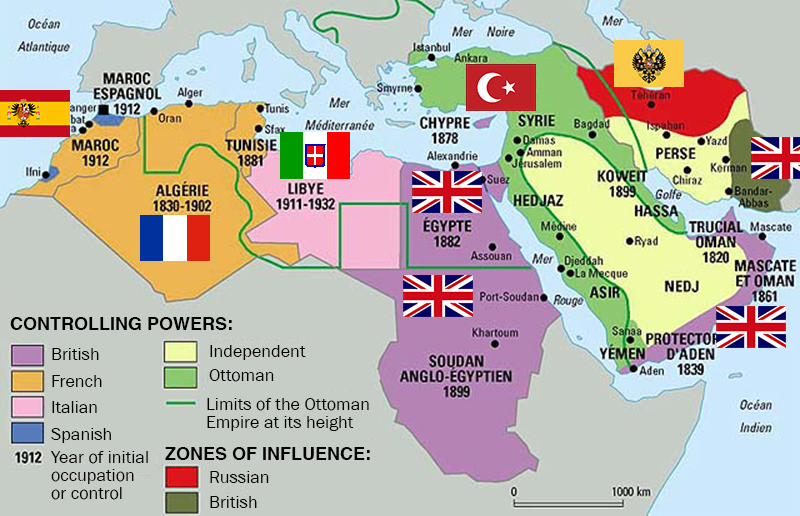
By the end of WW1, the Ottoman Empire had been defeated and it was up to the European nations to carve up the remaining land. So naturally they just closed their eyes and scribbled on a map.
 |
| http://www.vox.com/a/maps-explain-the-middle-east |
This is important because each country imposed different policies on their respective zones of influence and also because when the countries gained independence, these borders were kept.
Thing 3: Religious Complexity
Most of us know that Christianity, Judaism, and Islam all started in the Middle East, so they're pretty prominent. You've also probably heard about how there are two different factions of the Islamic faith: Sunni and Shiite. Aren't we smart? Here's what the distribution of those two factions looks like:
 |
| You can tell this map isn't going to be too confusing because it only has two colors (not including the ocean). http://www.vox.com/a/maps-explain-the-middle-east |
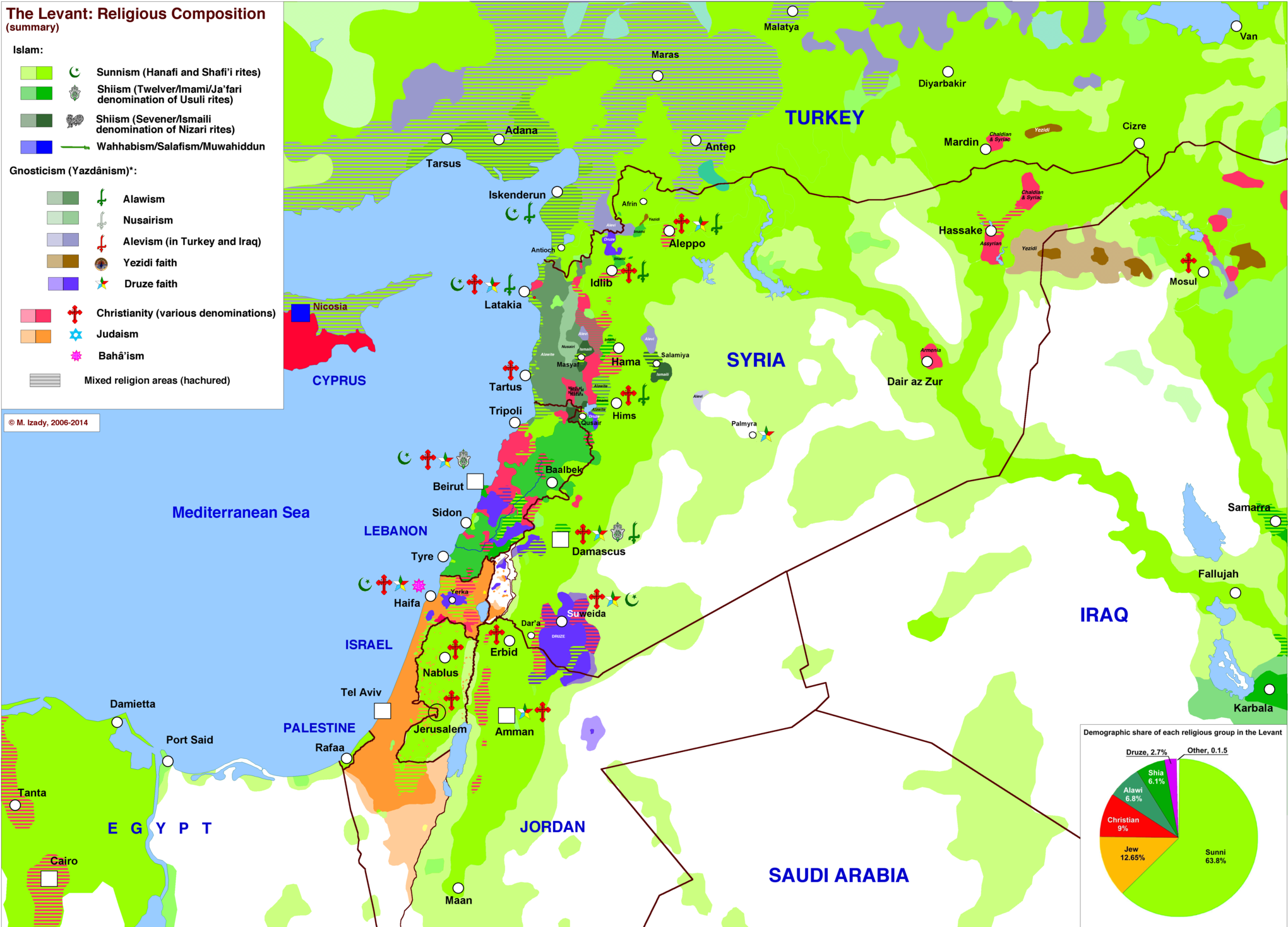
If we zoom into Syria and take a closer look at it's religious diversity we get the following techno-party map.
 |
| This map is like the neon techno party of religious dispersion and it's giving me a seizure just looking at it. Also note the return of the ambiguously marked hashed areas. http://www.vox.com/a/maps-explain-the-middle-east |
Lebanon features communities of Sunnis, Shias, Christians, and Druze (whatever that is). A 15 year civil war from 1975 to 1990 led to a lot of killing between these religious groups. Now a similar war is occurring in Syria, which is majority Sunni, but has sizable groups of Christians, Druze, and Shia. An interesting and probably important note about Syria is that despite being the minority religion, Bashar al-Assad and much of his government are all Shia Muslim.
Thing 4: Global Position and Resources (AKA, the final piece needed for a perfect shitstorm)
Okay, things are pretty complicated in the middle east. But remember, the Middle East is really, really far away. So why does it matter to us? How come every time I turn on the news I'm hearing about it?
The answer to that, you might have guessed, is pretty complicated; but it also helps explain why the region continues to be so unstable. See, by some kind of horrific stroke of bad luck, this already sensitive region happens to be a key global geo-political strategic hotspot. Because of course it is.
For this reason, Geographer Saul Bernard Cohen calls the middle east a "shatter-belt," which he describes in his book as:
"a region torn by internal conflicts whose fragmentation is increased by the intervention of external major powers. The interveners seek to extend their influence over the region by offering military, political, and economic support to their clients."
THE SHATTERBELT (read in a slow gravelly monster truck announcer's voice from now on) might be the coolest and simultaneously worst name you could have to describe your living space. Whenever I hear it, I think of one of those WWE heavyweight champion belts you see wrestlers carrying around all the time.
 |
| SUNDAY SUNDAY SUNDAY |
And the rest of the world is a bunch of world class WWE RAW SHOWDOWN wrestlers.

And so all the countries of the world are wrestling over control of the SHATTERBELT.
Unfortunately for the citizens living in the Middle East, all this fighting in their backyards tends to mess things up.
Most recently, the Middle East SHATTERBELT has been the meeting point between the US and Russia during the Cold war. With tensions rising again between the US and China/Russia, it makes sense that the US is a bit worried about what's going on here.
What's crazy is that this isn't the first time the Middle East has served as the meeting point for global superpower. Well before the Cold War, it was fought over by British Empire and Romanov Russia, and before that it was the battle grounds between the Byzantine and Ottoman empires. As we'll learn, the Middle East has somehow consistently been the exact spot where the world's competing superpowers somehow end up meeting. For thousands of years. Shit.
In addition to just being in the wrong place at the wrong time, the SHATTERBELT is also important for its resources. Now I'm sure you've already heard that oil is a pretty big deal in the Middle East. But oil isn't the only thing. There are two sub-things I want to point out.
Sub-Thing 4.1: The Straight of Hormuz
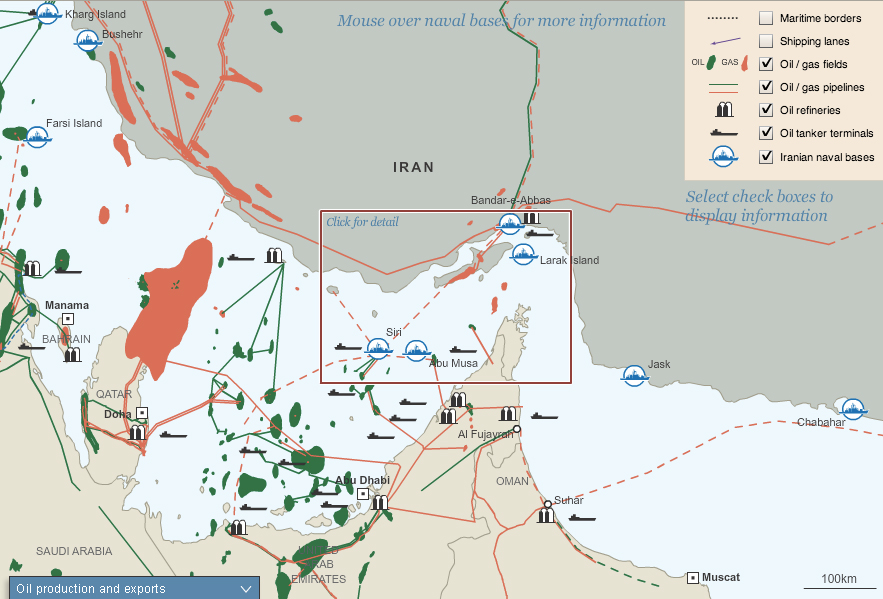
Just about all of the oil exported from the middle east is dependent on access to this narrow path of water between Iran and the Arabian peninsula. In 1980, President Jimmy Carter saw just how important of a piece it was to holding influence over the SHATTERBELT, so he positioned US forces in such a way that they could suplex the shit out of anyone that threatened our access to it. This was known as the "Carter Doctrine" which is a decidedly benign name for a wrestling move that when performed could ignite a third world war.
 |
| http://www.vox.com/a/maps-explain-the-middle-east |
Naturally, all the other countries yearning for control of the SHATTERBELT decided they should do the same, and now this tiny stretch of water is one of the most heavily militarized in the world.
Sub-Thing 4.2: Suez Canal
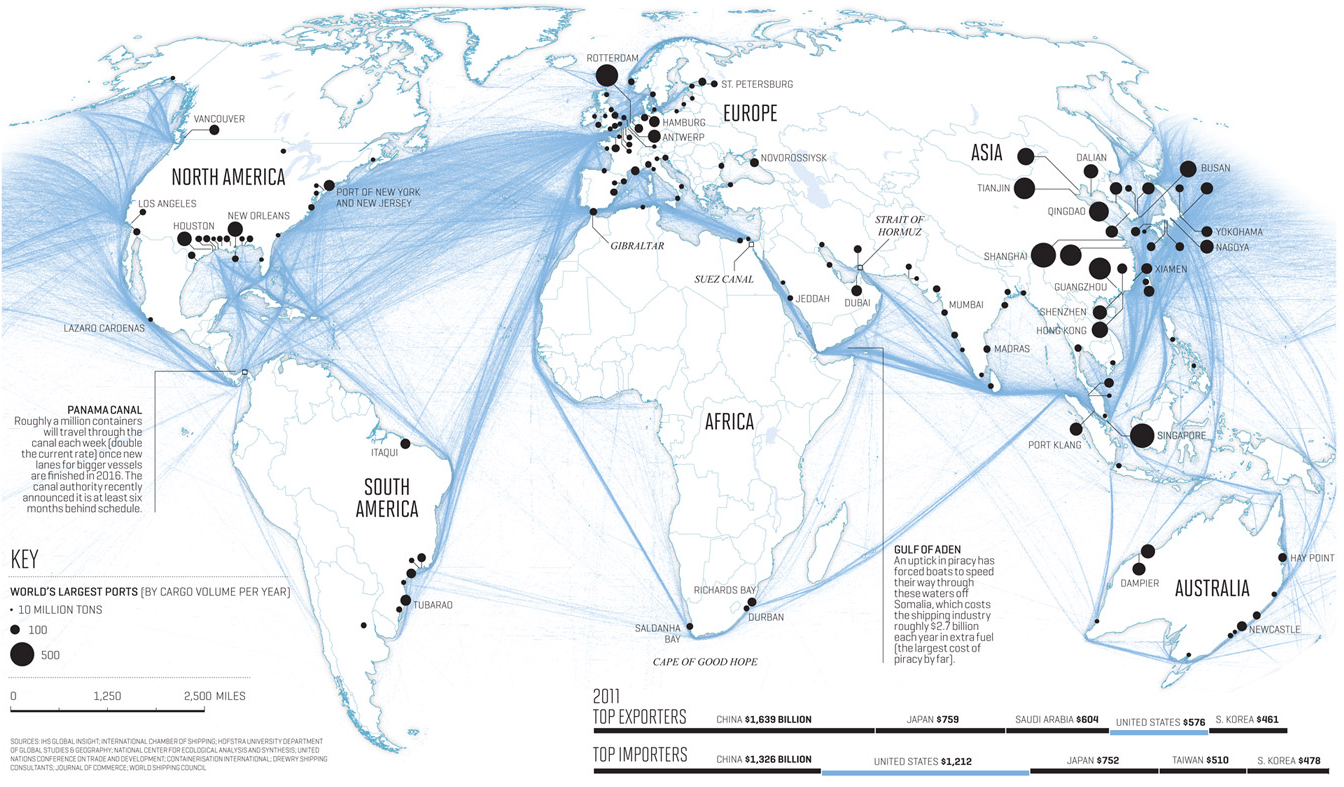
The Suez Canal was built in 1868. Located in Egypt, it's only 10 miles long, but incredibly important in that it made transport of good between Europe and Asia infinitely easier. Today, about 8 percent of all global trade makes its way though this stretch of water. It's so important, that in the 1880s, the major world powers signed a contract that the canal would "forever be open to ships of all nations no matter what"; an agreement that I'm sure nobody is ever going to break.
 |
| http://www.vox.com/a/maps-explain-the-middle-east |
Let's recap.
So why did this happen? what can we do about all of this? How do we address these problems? Is there ever going to be a solution?
The answers to these questions go back a long, long way. Well before ISIS had twitter, before humans had computers, before the cold war, before WW2 and WW1, before we knew about oil, before expansive empires and the birth of religion, before the invention of writing and pottery, before the formation of the world's first city, back before human civilization as we know it even existed.
That's where we start next time: 6 million BC.
<script>
(function(i,s,o,g,r,a,m){i['GoogleAnalyticsObject']=r;i[r]=i[r]||function(){
(i[r].q=i[r].q||[]).push(arguments)},i[r].l=1*new Date();a=s.createElement(o),
m=s.getElementsByTagName(o)[0];a.async=1;a.src=g;m.parentNode.insertBefore(a,m)
})(window,document,'script','//www.google-analytics.com/analytics.js','ga');
ga('create', 'UA-64536787-1', 'auto');
ga('send', 'pageview');
</script>
Sunday, May 31, 2015
A Closer Look at Income Inequality
We've all heard it. The new political buzzword: Income inequality. We're told it's caused by the big fat cat CEOs that are taking increasingly larger paychecks while the rest of us normal people are left making next to nothing, even as worker productivity increases. They are crushing us into a fine poverty stricken powder, effectively forcing the American middle class into slave labor. Articles written with such tenacity that even the most mild mannered person's blood would be boiling.
"CEO Pay Continues to Rise as Typical Workers are Paid Less" -Economic Policy Institute
"Despite substantial gains in productivity since the 1970s, worker pay has remained flat. " -ThinkProgress
"CEO-to-worker pay gap is obscene" -LA Times
"CEOs get paid too much, according to pretty much everyone" -Harvard Business Review
"The pay gap between CEOs and workers is much worse than you realize" -Wash Post
But is this really the case? The problem with these studies is that they are made in the absence of comprehensive data on wages paid by companies/firms (which you would think is pretty important for a study about income inequality). For instance, I recently saw a "study" that said CEOs are paid 380 times more than the average worker. But the authors used average CEO pay from only the top 180 Fortune 500 companies and compared it to the average US worker. That's egregious cherry picking. A more accurate study would be to compare the CEO pay of ALL companies (which is much, much lower) with the average US worker, rather than just the most successful companies. Or perhaps comparing the top CEOs pay with the pay of the same percentage of wage earners (think Lebron James, Albert Pujols, Tom Cruise). But that wouldn't make for a very exciting headline.
Since we're about to storm the houses of every CEO in the country with our pitchforks, there is obviously a need for more robust data analysis. A recent study published in the National Bureau of Economic Research did just that. The authors looked at employer-employee data for US firms from 1978-2012. The data set was a one-sixteenth percent representative sample of workers from a 100% population of US firms between 1978 and 2012 (i.e., it's not cherry data picked). It is based on administrative records so there is very little measurement error compared to survey-based data.
"Pay differences within employers have remained virtually unchanged, a finding that is robust across industries, geographical regions, and firm size groups."
So no, your boss isn't taking raise after raise while you are stuck making next to nothing. In fact, the data also shows that individuals in the top one percent are paid LESS relative to their firms' mean incomes than they were in 1982. So the pay gap between CEOs and the workers of a company is actually getting smaller!
So where's the economic inequality coming from then?
"Virtually all of the rise in earnings differences between workers is accounted for by increasing differences in average wages paid by employers."
I've constructed a shitty example to help make it more clear. Jim works for Company A. In 1978, the CEO of Company A made three times more than Jim. From 1978 to 2012, the wages of both Jim and Company A's CEO increased, but they increased at the same rate, so their pay difference didn't change. To explain the rise in income inequality, we need to look at what's happening over in Company B, where Simeon works. In 1978, the CEO of Company B made three times more than Simeon. Again, from 1978 to 2012, the wages of both Simeon and Company B's CEO increased at the same rate, meaning their pay gap stayed the same. The key however, is that wages for both Jim and the CEO over at Company A increased at a higher rate from 1978 to 2012 than the the wages for Simeon and the CEO over at company B.
The results of this study are true across regions, industries, sex, age, and tenure. (An interesting side note, when the author's looked at the trends based on gender, they found that the pay gap between gender is rapidly closing.)
These empirical results fly directly in the face of bleeding heart liberals that claim "a key driver of wage inequality is the growth of chief executive officer earnings and compensation." (A major finding of Picketty).
So what's causing certain companies to pay their employers better than others?
The authors offer a few explanations, but they are currently conducting more research to find the answer.
Reason 1: Growing productivity differences between firms
Simply put, some companies are just better than others.
Reason 2: Increased sorting
In the 1980s, firms were employing workers from a broader set of skill levels, but have become increasingly specialized over time. Due to the rise of specialized professions, some firms pay much higher average wages because their average worker quality has increased.
Intrigued by these results, I decided to look at what the top 30 paying firms are in the US (you can find the list here.). The highest-paying companies in America include Facebook, Cisco, Microsoft, Google, Apple, eBay, SanDisk, and various banks and oil companies. The fact that a lot of these companies are at the leading edge of technological development explains why their workers are making more compared to someone working at McDonalds. As technology advances, this will likely lead to even further income inequality as the skill set needed to operate and manufacture increasingly complex and innovative products and services at tech companies increases, while the skill set required for flipping burgers at McDonalds does not change.
But what about banks? Why is that such a lucrative business?
Quantitative easing from the Federal Reserve. Here's how it works:
"The Federal Reserve buys federal treasury bonds from big banks, at an artificially high price. The banks pocket the profit and invest it in other assets such as stocks, driving up their price and making more money. The Fed could buy the treasury bonds directly from the U.S. Treasury Department, but that wouldn't give free money to the banks, which is the whole point of QE." (Read the whole story if you want to see how QE also causes a rise in stock prices, further benefiting only the richest of Americans)
In the end, the income inequality is likely a combination of changing technology and economic markets along with a massive quantitative easing program designed to give free money to the richest banks. The key here is that you need to put your pitchfork away. CEOs are not the reason you aren't making more money.
"CEO Pay Continues to Rise as Typical Workers are Paid Less" -Economic Policy Institute
"Despite substantial gains in productivity since the 1970s, worker pay has remained flat. " -ThinkProgress
"CEO-to-worker pay gap is obscene" -LA Times
"CEOs get paid too much, according to pretty much everyone" -Harvard Business Review
"The pay gap between CEOs and workers is much worse than you realize" -Wash Post
But is this really the case? The problem with these studies is that they are made in the absence of comprehensive data on wages paid by companies/firms (which you would think is pretty important for a study about income inequality). For instance, I recently saw a "study" that said CEOs are paid 380 times more than the average worker. But the authors used average CEO pay from only the top 180 Fortune 500 companies and compared it to the average US worker. That's egregious cherry picking. A more accurate study would be to compare the CEO pay of ALL companies (which is much, much lower) with the average US worker, rather than just the most successful companies. Or perhaps comparing the top CEOs pay with the pay of the same percentage of wage earners (think Lebron James, Albert Pujols, Tom Cruise). But that wouldn't make for a very exciting headline.
Since we're about to storm the houses of every CEO in the country with our pitchforks, there is obviously a need for more robust data analysis. A recent study published in the National Bureau of Economic Research did just that. The authors looked at employer-employee data for US firms from 1978-2012. The data set was a one-sixteenth percent representative sample of workers from a 100% population of US firms between 1978 and 2012 (i.e., it's not cherry data picked). It is based on administrative records so there is very little measurement error compared to survey-based data.
The results.
"Pay differences within employers have remained virtually unchanged, a finding that is robust across industries, geographical regions, and firm size groups."
So no, your boss isn't taking raise after raise while you are stuck making next to nothing. In fact, the data also shows that individuals in the top one percent are paid LESS relative to their firms' mean incomes than they were in 1982. So the pay gap between CEOs and the workers of a company is actually getting smaller!
So where's the economic inequality coming from then?
"Virtually all of the rise in earnings differences between workers is accounted for by increasing differences in average wages paid by employers."
I've constructed a shitty example to help make it more clear. Jim works for Company A. In 1978, the CEO of Company A made three times more than Jim. From 1978 to 2012, the wages of both Jim and Company A's CEO increased, but they increased at the same rate, so their pay difference didn't change. To explain the rise in income inequality, we need to look at what's happening over in Company B, where Simeon works. In 1978, the CEO of Company B made three times more than Simeon. Again, from 1978 to 2012, the wages of both Simeon and Company B's CEO increased at the same rate, meaning their pay gap stayed the same. The key however, is that wages for both Jim and the CEO over at Company A increased at a higher rate from 1978 to 2012 than the the wages for Simeon and the CEO over at company B.
The results of this study are true across regions, industries, sex, age, and tenure. (An interesting side note, when the author's looked at the trends based on gender, they found that the pay gap between gender is rapidly closing.)
These empirical results fly directly in the face of bleeding heart liberals that claim "a key driver of wage inequality is the growth of chief executive officer earnings and compensation." (A major finding of Picketty).
So what's causing certain companies to pay their employers better than others?
The authors offer a few explanations, but they are currently conducting more research to find the answer.
Reason 1: Growing productivity differences between firms
Simply put, some companies are just better than others.
Reason 2: Increased sorting
In the 1980s, firms were employing workers from a broader set of skill levels, but have become increasingly specialized over time. Due to the rise of specialized professions, some firms pay much higher average wages because their average worker quality has increased.
Intrigued by these results, I decided to look at what the top 30 paying firms are in the US (you can find the list here.). The highest-paying companies in America include Facebook, Cisco, Microsoft, Google, Apple, eBay, SanDisk, and various banks and oil companies. The fact that a lot of these companies are at the leading edge of technological development explains why their workers are making more compared to someone working at McDonalds. As technology advances, this will likely lead to even further income inequality as the skill set needed to operate and manufacture increasingly complex and innovative products and services at tech companies increases, while the skill set required for flipping burgers at McDonalds does not change.
But what about banks? Why is that such a lucrative business?
Quantitative easing from the Federal Reserve. Here's how it works:
"The Federal Reserve buys federal treasury bonds from big banks, at an artificially high price. The banks pocket the profit and invest it in other assets such as stocks, driving up their price and making more money. The Fed could buy the treasury bonds directly from the U.S. Treasury Department, but that wouldn't give free money to the banks, which is the whole point of QE." (Read the whole story if you want to see how QE also causes a rise in stock prices, further benefiting only the richest of Americans)
In the end, the income inequality is likely a combination of changing technology and economic markets along with a massive quantitative easing program designed to give free money to the richest banks. The key here is that you need to put your pitchfork away. CEOs are not the reason you aren't making more money.
Monday, August 11, 2014
St. Louis Riots - Part 1
The recent events in St. Louis have left me incredibly saddened for two reasons reasons. First, an unarmed young man only one week away from starting college was shot and killed by a police officer. I remember how excited I was in the weeks before I left for college. I'm sure the last thing on this kid's mind was the possibility of being shot to death by a cop. Unfortunately, this is just another incident in what is becoming a disturbing trend of police brutality across the US. As a libertarian, I have a healthy dose of skepticism with regard to our civil 'servants.' Sometimes this skepticism is misrepresented as paranoia. And yet here we are, mourning the death of another unarmed kid at the hands of a cop.
Second, I am saddened by the response of some in the St. Louis community. To protest and to loot are two very different things. To those that are peacefully protesting, I would be out there with you if I could (that means if it wasn't dangerous and I was in St. Louis). I truly hope that a full investigation into this incident is carried out and that justice is served. However, to those are are taking the opportunity to loot and riot: if change is what you truly want, this is not the way to achieve it.
Tonight I'll focus on the latter topic (looting and the culture of inner cities). The next post will be about the problem of police brutality in the US.
"They Never Had a Chance"
It seems as though the first response many of us have in the face of these kinds of events is "they didn't know any better." There is almost a perverse desire to remove as much responsibility from the individual as possible. We cite socioeconomic circumstances to account for the present actions of criminals, as if the individual never had a choice in the matter. I think we need to be very careful about what message we send when we say "society is not giving these kids a chance." If we aren't clear, we run the risk of excusing the ignorance and violence that permeates through the culture.
If these truly kids "are set up for failure" we need to ask whose fault that is. Is it the government's fault for not addressing the issue of poverty? I'm always a bit shocked when I first hear this argument. It seems like there's plenty of programs and special interests groups dedicated to the advancement of blacks in America. But whenever inner-city youth act up, the response is such that you'd think the emancipation proclamation had been declared yesterday and blacks had been thrown out of the farms and into the streets without so much as a good-luck pat on the back. Is it true? Are we really leaving black Americans high and dry?
The War on Poverty
In 1964, President Johnson declared the a war on poverty. Since then, some $16 trillion has been spent to alleviate the woes of the lower class. Hundreds of programs have sprung up, including the Earned Income Tax Credit, the Child Tax Credit, Unemployment Insurance, Food Stamps (SNAP) and Social Security. In 2012, the US government at the state, local, and federal level spent a total of $1 trillion dollars on poverty programs. That means we literally could have *given* $20,000 to every single poor family in America and it would have cost less than these programs.
What about education? Are our public schools working? Do we give them enough attention and funding? What about the caliber of the teachers? In Missouri, 30% of the state and local budget goes to funding education--more than any other sector. Healthcare is second at 26%. The rest of the sectors combined make up for the final 44% of the budget. This means that education is, by far, the top priority for spending in Missouri.
Much has been done to alter the fate of inner-city children's education. In 1980, the Voluntary Interdistrict Coordinating Council began transferring thousands of black children living in the city of STL to suburban school districts. This gave parents a choice when their local schools were failing. In the meantime, St. Louis Public Schools (SLPS) was establishing magnet schools designed to provide quality education that would attract a diverse student body from the surrounding suburbs in hopes of revitalizing the city's school system. Unfortunately, while the VICC flourished, the inner city schools lagged behind. Due to a continued decline in overall quality, in 2007 the Missouri Department of Elementary and Secondary Education stripped the STL Public School system of its accreditation and appointed a three-person special advisory board in hopes of saving the district. Since the change, high-school graduation rate has increased by 18% and $25 million in debt has been eliminated.
(Libertarian plug: what has been one of the secrets to the successful turnaround? "Mr. Adams said his 18 months as chief of staff in New Orleans, where he oversaw the opening of 33 traditional schools and 26 charter schools, convinced him that choice and competition are vital. "It puts people on notice that public schools won't necessarily have kids in them just because they are there," he said. Now, he continually warns principals that if they cannot keep enrollment up, he will close the schools. In his first two years in St. Louis, Mr. Adams closed 14 schools, dismissed about 10% of principals and has since replaced about 60% of the system's 77 leaders. He has transformed 11 schools by firing half the teaching staff and installing new principals.")
Admittedly, there are still improvements to be made. The issue of inner city education is certainly a difficult one. But in light of this reform, can it really be said that nobody was fighting to give these kids a chance?
What about the cost of education? Is there an unfair system in place that keeps poor black families from having an opportunity to afford college? According to the US Department of Education's National Center for Education Statistics:
"In 2007–08, a higher percentage of Black full-time, full-year undergraduate students received financial aid than did White, Hispanic, Asian, and Native Hawaiian or Other Pacific Islander full-time, full-year undergraduates and full-time, full-year undergraduates of two or more races. Ninety-two percent of full-time, full-year Black undergraduate students received financial aid, compared to 85 percent of Hispanic students, 77 percent of White students, 68 percent of Asian students, 80 percent of Native Hawaiian or Other Pacific Islander students, and 83 percent of students or two or more races."
So a greater percentage of black students are receiving some sort of financial aid. But is it an amount that will actually make a difference?
"In 2007–08, among full-time, full-year students who received financial aid, Black students received higher average amounts of aid ($13,500), than White ($12,900), Hispanic ($11,400), Asian ($12,600), and American Indian/Alaska Native ($10,900) students."
This means that if you are black, you not only have the best statistical chance of getting a scholarship, but the scholarship you receive will be at or near the top of those given out in terms of dollar amount.
I'm not saying this is a bad thing--I am simply pointing this out to dispel the myth that these people are not getting a chance. If you actually look at the numbers, young blacks are being rooted for more-so than any other group in America right now. (I should note that there is a large amount of evidence out there that suggests the large amount of social welfare has slowed the decline in poverty rates. But that's not what I'm discussing here.)
A Change in Culture
I came home for St. Patrick's day this past spring and went to the parade downtown. I found it really odd that people were cheering as the police showcased their new armored vehicles. People were literally applauding the militarization of the police forces.
But this is obviously not how to address it. Sure, there might be hundreds of years of pent up anger within the black community, but how does lighting a Quiktrip on fire or stealing a pair of sneakers do anything to fix that problem? In what universe does that solve anything? If you're sick of being treated like a violent degenerate thief, how do you decide that going out en masse and committing violent, degenerate acts of thievery will accomplish anything?
Any amount of defense for these looters is too much. You don't need to spend 30 billion dollars on education to teach someone that stealing is inappropriate. If these kids didn't know any better, why are they covering their faces with shirts as they loot the stores? The problem is not a lack of knowledge--the lifelines have already been thrown (see above). The problem is a lack in desire or willpower to take personal responsibility and change the culture.
Parents: I'm looking at you. In my opinion, the behavior of the parents is at the heart of this problem. No amount of government funding or education reform can ever replace the values and morals that are taught at home. If teachers spend their days stressing the importance of an education only to be undermined by a dysfunctional parental unit, nothing will be fixed. It's easy for a parent to say "well I grew up in a shitty household, so how am I supposed to know any better?" and allow the status quo to continue. But as soon as those words are spoken, the parent has implicitly acknowledged that it is now his or her responsibility to stop the cycle.
Immediately following this admission, the parent should begin finding ways to be a better parent. Anything else is a refusal to rise above the circumstances to take not just personal responsibility, but to also start the ball rolling for positive change in the future. Refusing to help future generations because nobody gave you a chance is nothing short of selfish.
Perhaps one of the more prominent figures currently preaching the need for a cultural change is Bill Cosby. He has called for an end to the blame game--replaced by a sense of personal accountability:
|
Naturally, during times of civil unrest we are reminded of the gains that Martin Luther King Jr. made during his years of activism. How would he have behaved if he were alive today? I think his writings give us a very strong answer. The following is a list of "commandments" that everyone wanting to join in MLK's Birmingham protests were required to read and agree to abide by. After reading this, ask yourself if he would have reacted to last night's actions at any of his protests. Would he have found excuses for their behavior, effectively condoning the events of last night by attributing them to a 'boiling over' of emotions? Or would he have scolded those that refuse to take responsibility for their actions and their futures today?
"I HEREBY PLEDGE MYSELF- MY PERSON AND MY BODY- TO THE NONVIOLENT MOVEMENT. THEREFORE, I WILL KEEP THE FOLLOWING TEN COMMANDMENTS:
1. Meditate daily on the teachings and life of Jesus.
2. Remember always that the nonviolent movement in Birmingham seeks justice and reconciliation—not victory.
3. Walk and talk in the manner of love, for God is love.
4. Pray daily to be used by God in order that all men might be free.
5. Sacrifice personal wishes in order that all men might be free.
6. Observe with both friend and foe the ordinary rules of courtesy.
7. Seek to perform regular service for others and for the world.
8. Refrain from the violence of fist, tongue, or heart.
9. Strive to be in good spiritual and bodily health.
10. Follow the directions of the movement and of the captain on a demonstration."
Subscribe to:
Comments (Atom)